Module week: Week 40 (starting 29 September 2026)
Recorded lecture — released online at the start of the module week, plus a 1-hour live lecture on Tuesday 29 September 2026, 10:00–11:00 CEST to introduce and announce the final project. The computer lab (Wednesday 13:00–17:00) and seminar (Friday 10:00–12:00) are held live over Zoom.
Module 6 focuses on automated scientific discovery and AI agents. You will learn how to design, build, and evaluate agentic workflows that plan experiments, orchestrate tools and data pipelines, and interface with lab automation. The module also opens the final project: the live session walks through the project brief, expectations, and timeline.
Lecturer: Wei Ouyang (Assistant Professor at KTH Royal Institute of Technology; DDLS Fellow)
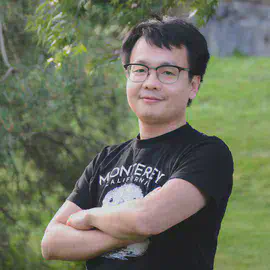
Wei Ouyang is an assistant professor in the Applied Physics Department at KTH Royal Institute of Technology in Stockholm, Sweden, and a Data-Driven Life Science fellow. He leads a team focused on building AI systems for next-generation life science. Wei earned his PhD at Institut Pasteur in Paris, where he developed ANNA-PALM, a deep learning method that significantly enhances super-resolution microscopy speed. He later worked as a postdoc with Emma Lundberg’s group, focusing on image analysis and whole-cell modeling. Wei is the founder of ImJoy, an open-source platform for deep learning tools, and co-founder of the BioImage Model Zoo and the AI4Life consortium. Learn more about his work here.
Lecturer: Gabriel Reder (Research associate at Cambridge University, UK)
Gabriel Reder is a research associate in automated laboratory discovery and informatics. He has focused especially on applications to mass spectrometry metabolomics and self-driving robotic laboratories.
Title: Accelerating Laboratory Scientific Discovery with AI
Discovery in the biological laboratory is a difficult and time-consuming process. At every step, practitioners are faced with repetitive, complex, and labor-intensive tasks. Generative AI, especially large language models, can allow scientists to automate many of these tasks including experimentation, compilation, and data analysis. In this lecture, we will explore some examples of how researchers can utilize modern AI tools to aid their discovery research in the lab and at the desk.
The computer lab notebook will be released at the start of the module week; you will present your lab work at the Friday seminar.