Table of Contents
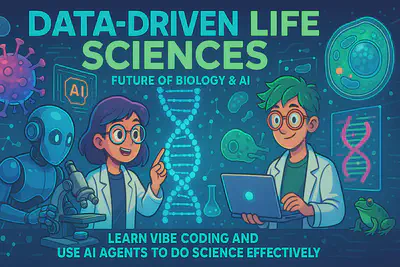
Welcome to the 2026 Data-Driven Life Sciences (DDLS) course — a hands-on master’s course in AI, biological data, and scientific computing. Across six modules you will learn to use AI to solve biological problems: working with real data (genomics, imaging, proteins, multi-omics), building and using AI agents, and designing AI-assisted research workflows.
Guest lecturers (DDLS Fellows, SciLifeLab Fellows, and SciLifeLab facility trainers) present real data, methods, and models underpinning current biological research. The course is primarily aimed at KTH Master’s students, and is also open to PhD students and other interested participants.
🔗 Join the Course Online (Zoom)
All live sessions — the computer labs (Wed 13:00–17:00), seminars (Fri 10:00–12:00), and the two live lectures (Module 1 introduction and Module 6 final-project briefing) — are held on the same Zoom meeting all term:
Meeting link: https://kth-se.zoom.us/j/66475726850
Bookmark this link — it is the same for every session. Session dates and times are on the schedule.
🚪 The Course Portal
The hands-on part of the course runs through the course portal. Each week it hosts the data owner you interview, issues the API key that connects your local AI agent, and lets you download the week’s dataset and your own transcripts. You’ll use it live in every Wednesday lab.
First time? Activate your account with the email you registered with and the course code we emailed you, then set a password. Full step-by-step instructions are on each module’s computer-lab page (start with Computer Lab 1).
Everything you need to know — how the labs work, the method, the setup guide, the assessment — lives here on the course website and stays available after the course ends. The portal holds the live, per-week pieces (the chatbot, your keys, the datasets).
Registration
Registration for DDLS 2026 is now closed. The course is offered online and free of charge.
Thank you to everyone who signed up. Accepted participants have been notified by email with the course details and joining information. If you have a question about your registration, contact us at ddls-course@scilifelab.se.
Intended Learning Outcomes
By the end of the course you will be able to:
- Describe the field of data-driven life sciences
- Summarize major application areas and their data types
- Give examples of typical analysis workflows
- Apply core statistical and machine learning methods to biological datasets
- Formulate simple models of biological phenomena
- Employ AI tools/agents to support reasoning, problem solving, and exploration
- Critically evaluate and responsibly integrate AI outputs into analyses
- Collaborate effectively with AI-assisted tools to enhance research productivity
- Present and review scientific literature
- Practice sound data management (collection, handling, sharing, analysis)
- Reflect on limitations, biases, risks, and ethical considerations of AI
- Reflect on broader ethical implications of data-driven life sciences
Course Format and Credits
The course consists of six required modules. Each module spans one week. Most lectures are pre-recorded and released online at the start of the module week, so you can watch them at your own pace — the exceptions are two live sessions: the Module 1 introduction and the Module 6 final-project briefing. The hands-on computer lab (Wednesday 13:00–17:00, run through the course portal) and the seminar (Friday 10:00–12:00) are held live over Zoom each week. Completing all modules plus the final project yields 7.5 ECTS.
Credit breakdown:
- Computer labs — 2.0 hp
- Final project — 3.0 hp
- Oral exam (presentation) — 2.5 hp
Modules and Certification
Both the computer lab and the seminar are mandatory and pass/fail assessed.
- Labs: Each week you take on someone else’s biological problem through the course portal — you interview a data owner to pin down the real question, then direct an AI agent to solve it and verify the result like a scientist. You submit your transcripts and a short report; the teaching team reads the transcript, not just the result. See each module’s computer-lab page for full instructions.
- Seminar: Each week you present and defend the work you carried out during that module’s computer lab. Presenters are drawn at random (7 min + 3 min discussion), so everyone prepares. See Seminar 1 for the format.
Final project: You carry out your own project on a topic that relates to the content of the course, culminating in a project report (all participants). Master’s students additionally give a mandatory oral presentation, graded A–F, which is the course grade. PhD students and other participants are assessed pass/fail, and their oral presentation is optional. Details will be announced during the course.
To receive ECTS credits or a certificate of participation you must actively attend and engage in all required sessions.
Self-Directed Learning
A core objective is to strengthen your ability to “learn how to learn.” You are encouraged to use modern AI tools (e.g., ChatGPT, Claude, Gemini) to explore concepts, draft code, and critique analyses—while remaining accountable for verifying outputs, documenting usage, and recognizing limitations and biases. This approach is integral to both labs and seminars.
Course Modules
Note: The six module topics are set. The guest lecturers for Modules 4 and 5 are still being confirmed. See the schedule for dates and session times.
- Module 1 — Introduction to Data-Driven Life Sciences
- Module 2 — Image Analysis and Microscopy
- Module 3 — Precision Medicine and Systems Biology
- Module 4 — Protein Structure and Molecular Biology
- Module 5 — Single-cell Transcriptomics and Genomics
- Module 6 — Automated Scientific Discovery and AI Agents
- Final Project — Apply what you learned to your own project (report for all; presentation for Master’s)
Assessment
Computer labs and seminars are pass/fail for everyone (attendance + satisfactory notebook / engaged participation).
Master’s students:
- Final project report — pass/fail
- Oral presentation (oral exam) — mandatory, graded A–F (this is the course grade)
PhD students and other participants:
- Final project report — pass/fail
- Oral presentation — optional
- Overall assessment: pass/fail
Peer review precedes final grading and feedback by the teaching team.
Communication and Groups
Announcements and posts: here
Questions: use the contact page here or email ddls-course@scilifelab.se.
Instructors
You will meet:
- Wei Ouyang, Assistant Professor in Biophysics (lectures, seminars, grading) wei.ouyang@scilifelab.se (course responsible)
- Songtao Cheng, PhD student (lectures support, labs, seminars) songtao.cheng@scilifelab.se
- Nils Mechtel, PhD student (lectures support, labs, seminars) nils.mechtel@scilifelab.se
Schedule
See the course schedule for dates and session details.
FAQs
Are there prerequisites?
The examined skill is directing and verifying an AI agent, not writing code by hand — so Python is not a hard entry requirement this year. You should be comfortable reading code and sanity-checking results at a basic level, have some scientific/biological curiosity, and be willing to work on someone else’s problem (a hard course rule — you may not use your own data). If you have never seen Python, the optional refresher on the prerequisites page gets you to the “I can read and check this” level, which is all you need.
When does the course run?
Autumn 2026, Period 1 (50% pace): 24 August – 23 October 2026. The course starts on 24 August 2026.
How do I register?
Registration for DDLS 2026 is now closed. If you signed up, watch for course information by email. For questions, contact ddls-course@scilifelab.se.
How do I access course material?
Each module page hosts its materials; we do not use KTH Canvas.
Can I attend the course remotely?
Yes, the entire course is conducted online via Zoom. The Zoom link will be shared with registered participants ahead of the course start.
What if I must miss a lab or seminar?
Labs and seminars are the mandatory live core. You may miss one mandatory session in total (a lab or a seminar, not one of each). Email ddls-course@scilifelab.se before the session — not after. If you miss a lab, you still submit that week’s transcripts and report.
Will lectures be recorded?
Recording is at the lecturer’s discretion; slides will be provided.
Can I use generative AI tools?
Yes—responsibly. Disclose AI assistance and attach any relevant conversation history for graded submissions.