Table of Contents
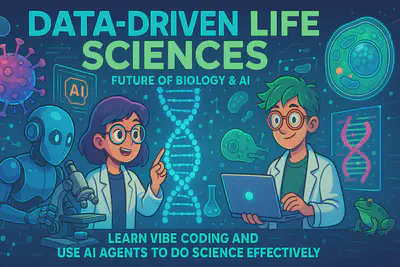
Welcome to the 2025 Data-Driven Life Sciences (DDLS) course. Across six modules you will explore how data science and AI enable discovery in proteomics, transcriptomics, structural biology, molecular simulations, imaging, and systems/precision medicine.
Guest lecturers (DDLS Fellows, SciLifeLab Fellows, and SciLifeLab facility trainers) present real data, methods, and models underpinning current biological research. The course is open to all Master’s and PhD students as well as other interested participants.
Registration
Registration is now closed for DDLS 2025.
Intended Learning Outcomes
By the end of the course you will be able to:
- Describe the field of data-driven life sciences
- Summarize major application areas and their data types
- Give examples of typical analysis workflows
- Apply core statistical and machine learning methods to biological datasets
- Formulate simple models of biological phenomena
- Employ AI tools/agents to support reasoning, problem solving, and exploration
- Critically evaluate and responsibly integrate AI outputs into analyses
- Collaborate effectively with AI-assisted tools to enhance research productivity
- Present and review scientific literature
- Practice sound data management (collection, handling, sharing, analysis)
- Reflect on limitations, biases, risks, and ethical considerations of AI
- Reflect on broader ethical implications of data-driven life sciences
Course Format and Credits
The course consists of six required modules. Each module spans one week with three core sessions: lecture(s) on Tuesday, a hands‑on computer lab on Wednesday (Google Colab notebooks), and a journal club on Friday. Completing all modules yields 7.5 ECTS.
Modules and Certification
Both the computer lab and the journal club are mandatory and pass/fail assessed.
- Labs: You receive a Jupyter notebook with guided exercises. Work in Google Colab, discuss during the session, and submit your completed notebook for evaluation.
- Journal club: You address a standard question set each week while discussing the assigned paper. Participation and contributions are graded.
Final project: Pairs (Master’s) or individual (PhD) projects culminate in a project report (all) and an oral presentation (Master’s only; PhD optional). Peer assessment precedes examiner grading.
To receive ECTS credits or a certificate of participation you must actively attend and engage in all required sessions of each selected module.
Self-Directed Learning
A core objective is to strengthen your ability to “learn how to learn.” You are encouraged to use modern AI tools (e.g., ChatGPT, Gemini) to explore concepts, draft code, and critique analyses—while remaining accountable for verifying outputs, documenting usage, and recognizing limitations and biases. This approach is integral to both labs and journal clubs.
Course Modules
Note: Module details are finalized for 2025. See the schedule for dates and session times.
- Introduction to data-driven life sciences
- Computational fundamentals, Python basics, reproducibility, first scientific AI agent, and research literature skills
- Lab and journal club details released at module start
- Image analysis and microscopy
- Image processing, segmentation, deep learning workflows; extend your agent with computer vision utilities
- Lab and journal club details released at module start
- Protein structure and molecular biology
- Structural data, protein modeling, AlphaFold pipelines, molecular visualization and analysis integration
- Lab and journal club details released at module start
- Single-cell transcriptomics and genomics
- scRNA‑seq workflows, QC, clustering, pathway/genomic analysis; add genomics functions to your toolkit
- Lab and journal club details released at module start
- Precision medicine and systems biology
- Multi‑omics integration, biomarker discovery, clinical data handling, systems modeling and AI in personalized medicine
- Lab and journal club details released at module start
- Automated scientific discovery and AI agents
- Agentic workflows, tool/data pipeline orchestration, and lab automation integration; evaluate and deploy AI agents for discovery
- Lab and journal club details released at module start
- Apply your integrated computational toolkit to a research problem (report for all; presentation for Master’s)
Assessment
- Computer labs: Pass/Fail (attendance + satisfactory notebook)
- Journal clubs: Pass/Fail (attendance + engaged participation)
- Project: Pass/Fail (execution + report)
- Oral exam (presentation): Graded A–F (Master’s required; PhD optional)
Peer review precedes final grading and feedback by the teaching team.
Communication and Groups
Announcements and posts: here
Questions: use the contact page here.
Instructors
You will meet:
- Wei Ouyang, Assistant Professor in Biophysics (lectures, journal clubs, grading) wei.ouyang@scilifelab.se (course responsible)
- Songtao Cheng, PhD student (lectures support, labs, journal clubs) songtao.cheng@scilifelab.se
- Nils Mechtel, PhD student (lectures support, labs, journal clubs) nils.mechtel@scilifelab.se
Schedule
See the course schedule for dates and session details.
FAQs
Are there prerequisites?
The students are expected to have basic knowledge of biology and programming in Python. If you are not familiar with Python, it will be helpful if you can go through the prerequisites.
How often does the course run?
Once per year (Period 1: August–October).
How do I register?
- KTH Master’s students: via the KTH course selection system
- PhD students and external participants: Google registration form above
How do I access course material?
Each module page hosts its materials; we do not use KTH Canvas.
Can I attend the course remotely?
Yes, the entire course is conducted online. All lectures and sessions will be held via Zoom. You can join the lectures, computer labs and journal clubs using this Zoom link.
What if I must miss a lab or journal club?
Attendance is mandatory. Contact the course responsible in advance; approved exceptions still require a completed notebook or a written response to the journal club questions.
Will lectures be recorded?
Recording is at the lecturer’s discretion; slides will be provided.
Can I use generative AI tools?
Yes—responsibly. Disclose AI assistance and attach any relevant conversation history for graded submissions.